Bun application runtime
Server-rendered routes, .ree templates, and plain TypeScript on Bun, organised so you can follow a request from URL to response.
Build from the database outward. Reepolee generates visible TypeScript routes, SQL, validation, forms, and translations, then leaves the application in your hands.
Reepolee is an open-source Bun application framework for backoffices, internal tools, member systems, administrative workflows, and other long-lived business software. It is designed for one developer or a small team carrying real operational responsibility.
Reepolee Framework is in beta. APIs, generators, and project conventions may still change before 1.0. The source is public so you can evaluate the current implementation directly.
Reepolee provides the repeatable parts of database-backed software in one inspectable project. Clone it under the MIT License, adapt the source, and keep the application with the code your organisation already maintains.
Server, routes, `.ree` templates, configuration, static assets, and project scripts live together in a repository you can inspect and change.
Generate schema metadata, validation, CRUD routes, queries, templates, translations, and navigation from the database model.
Users, invitations, authentication, authorization, localization, images, modules, and administration routes are already represented.
Installation, generators, project structure, security, deployment, logs, and upgrades are documented from first run to production operation.
ReeWeb is a complete MIT-licensed static-site generator. Use it alone for sites and documentation, or run it alongside Reepolee when a site later needs managed content, users, or workflows.
Each capability links to implementation documentation, so you can inspect the real workflow instead of relying on a feature list.
Server-rendered routes, .ree templates, and plain TypeScript on Bun, organised so you can follow a request from URL to response.
Generate routes, SQL, validation, templates, translations, and navigation from tables, then adapt the result as the domain grows.
Authentication, authorization, invitations, CSRF protection, profiles, and rate limiting are documented framework parts.
The server sends complete HTML. Browser-native JavaScript handles the interactions that need it, with no hydration layer to maintain.
A local-only agent mode and an in-tree MCP server expose application workflows without hiding the project behind another platform.
Run SQLite or MySQL and deploy on a VPS or on-premise, with queues, caching, and object storage available when needed.
The generator makes stable, repetitive decisions consistently. Its output lives beside your domain code, where you can review it, test it, and change it without waiting for a framework extension point.
Begin with the tables, columns, constraints, and relationships that represent the organisation.
Use `reeman` and the resource generators to create the schema and CRUD starting point consistently.
Adjust routes, validation, queries, templates, and workflows in ordinary project files.
A real generator workflow
bun reeman
bun reeman schema members
bun reeman crud members --translate
The database remains the source of truth. Generation handles stable, repeatable decisions while application-specific behavior stays in code you review.
12-minute walkthrough
This is the complete first run, without a prepared application hidden behind the edit: create the project with bun create, execute the supplied SQL, generate CRUD routes, create an authorised user, and open the resulting indexes and forms.
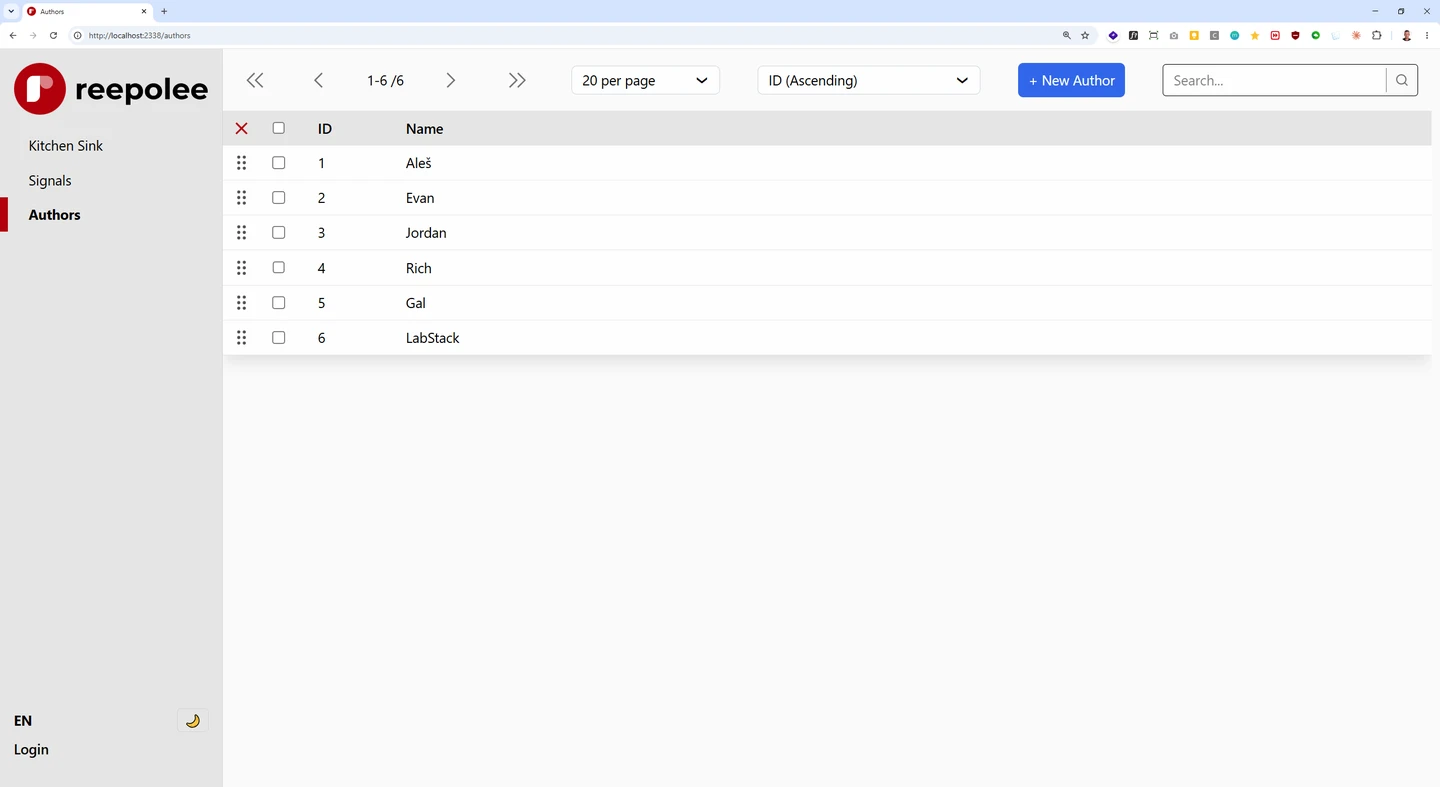
Generated backoffice
This authors index was generated from a database table. Pagination, sorting, search, row selection, creation, navigation, and route structure arrive together; the query, handler, template, and translations remain ordinary files.
Reepolee has no production package installation between the code you reviewed and the process serving it. Bun runs the core application, while vendored third-party code is versioned with the project.
The operational model
git pull
bun startReepolee is aimed at applications whose staff, members, clients, or customers depend on a system maintained by one developer or a small team. It does not claim to be the answer for every traffic pattern or product category.
The product choices are not hidden conventions. These notes explain why we generate visible code, keep the runtime small, choose predictable interfaces, and operate on infrastructure we control.
Why predictable backoffice interfaces serve people who use software to complete another job.
Read the noteWhy generated code remains visible, adaptable, and maintained with the application.
Read the noteWhy a small runtime is practical now and what it changes operationally.
Read the noteWhy the location and operation of software remain business decisions.
Read the noteReepolee is open source under the MIT License. Create a project with bun create reepolee/reepolee, follow the installation guide, and inspect every part of the resulting application. Expect APIs and generators to evolve while the project moves toward 1.0.