Caching
Reepolee can cache the results of CRUD list queries (search_records) in Redis, keyed by the exact query parameters and invalidated automatically whenever the underlying table changes. The cache is off by default and opt-in - it only activates when CACHE_ENABLED=true and Redis is available (REDIS_ENABLED=true plus a REDIS_URL). With it off, the cache layer is a transparent no-op: every call runs the query directly.
The implementation lives in $lib/cache. It is deliberately small - one search() wrapper, one invalidate() call, plus a few admin helpers. There is no per-route configuration, no manual key management, and no stale-data risk from forgetting to clear a key: writes invalidate the cache by table dependency.
Enabling the Cache
Three environment variables control it:
CACHE_ENABLED=true
REDIS_ENABLED=true
REDIS_URL=redis://localhost:6379
The guard is fail-loud: if CACHE_ENABLED=true but Redis isn't enabled (REDIS_ENABLED off or no REDIS_URL), the process exits at startup with an error rather than silently running without a cache. When CACHE_ENABLED is unset or false, cache.search() simply calls the query function and cache.invalidate() does nothing - so generated routes that call into the cache work identically whether or not caching is turned on.
How It Works
Generated CRUD routes already wire the cache into their search_records path. Each generated sql.ts exports two constants the cache relies on:
TABLE_NAME- the table this route owns, used as the invalidation key.VIEW_DEPENDENCIES- every table a list query reads from (the table itself plus any joined foreign-key tables).
The caching is wired inside the generated search_records() function - the route handler just calls search_records(...) as usual and gets caching for free. Inside search_records, the query is wrapped in timed_query() and then cache.search():
// inside the generated apps/main/<table>/sql.ts
return await timed_query(TABLE_NAME, "search_records", async () =>
    cache.search(
        "products", // the route key
        { search, after, before, is_last, limit, order_by, scope_clause },
        VIEW_DEPENDENCIES, // e.g. ["products", "categories"]
        async () => {
            // ...the actual cursor-paginated SQL...
        },
    ),
);
cache.search():
- Builds a cache key from the route and the sorted, non-empty params:
sql:cache:{route}:after:{...}:limit:{...}:order_by:{...}:search:{...}. The key is plain concatenation, not a hash - it is human-readable and debuggable inredis-cli. - Returns the cached JSON on a hit.
- On a miss, runs the query, stores the result with a 5-minute TTL (
DEFAULT_TTL_S = 300), and registers the cache key in a Redis SET per dependency table (sql:deps:{table}).
If Redis errors at any point, cache.search() logs a warning and falls back to running the query directly - a Redis outage degrades to "no cache," never to an error.
Invalidation
Caching read queries is easy; the hard part is keeping them fresh. Reepolee uses dependency-set invalidation: every cached search registers itself under each table it depends on. When a write happens, every cached entry depending on that table is dropped.
Generated create, update, delete, and bulk-delete handlers call cache.invalidate(TABLE_NAME) after the mutation succeeds:
await cache.invalidate(TABLE_NAME);
invalidate() reads the sql:deps:{table} SET, deletes every cache key in it, then deletes the SET itself. Because a list query that joins products and categories registers under both sql:deps:products and sql:deps:categories, editing a category correctly busts the product list that displayed its name.
The Cache Admin Module
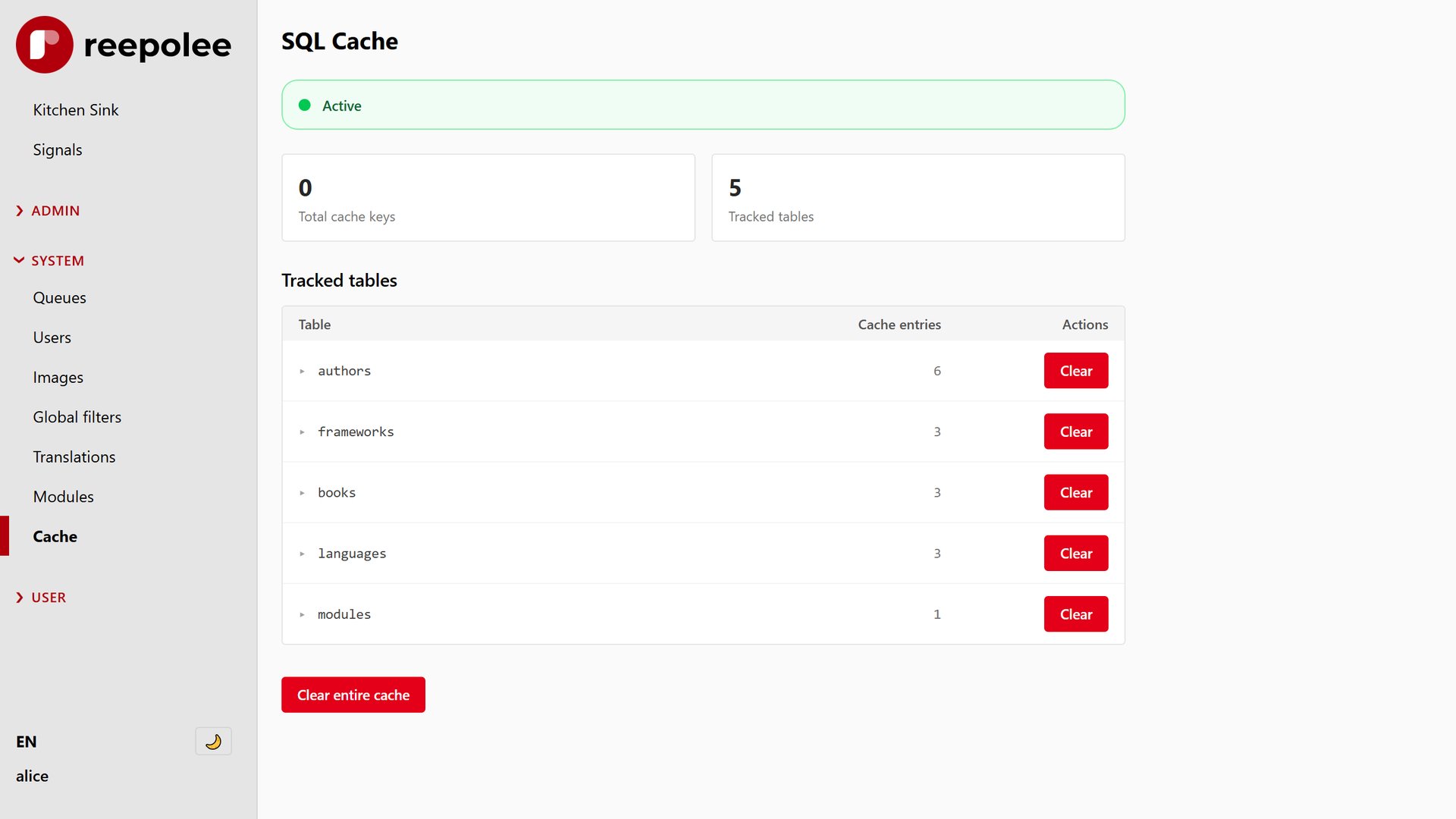
The system module at /cache (route apps/reeman/cache/) gives a live view of the cache:
- Whether caching is enabled (
cache.is_enabled()). - Total
sql:cache:*keys andsql:deps:*dependency sets (cache.get_status()). - A per-table breakdown of how many cached entries each table holds.
- A button to flush everything (
cache.invalidate_all()), which deletes everysql:*key and returns the count removed.
This is useful for confirming the cache is warming up as expected and for manually clearing it after a bulk data import that bypassed the normal write handlers.
Tuning
The TTL is a single constant in $lib/cache (DEFAULT_TTL_S, 300 seconds). It is a safety net, not the primary freshness mechanism - invalidation keeps data correct, and the TTL only bounds how long an orphaned entry (one whose invalidation somehow failed) can live. Raise it if your data is mostly read-only; lower it if you want a tighter ceiling.
The cache only wraps generated CRUD search_records queries. Hand-written queries and single-record lookups are not cached - if you want to cache those, call cache.search() yourself with an appropriate route key and dependency list, and add a matching cache.invalidate() to whatever writes that data.
Note:
apps/reeman/usersuses offset pagination and is not cache-integrated - it has noVIEW_DEPENDENCIESexport and runs its query directly. Treat it as a hand-written system-route exception, not a template.